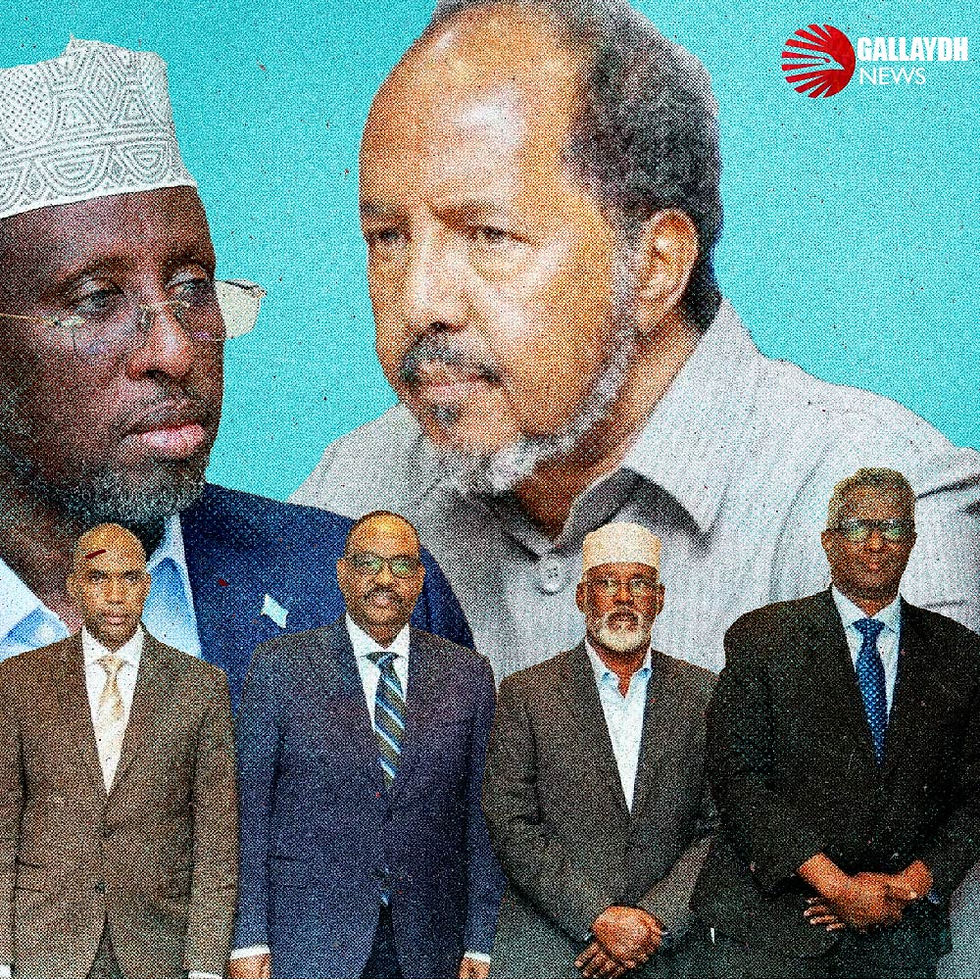
Somalia Plunges into a Constitutional Vacuum as Opposition Coalition Moves to Uproot Hassan Sheikh's Administration

MOGADISHU (May 16, 2026) Somalia's political history entered a dark new chapter on May 16, 2026, following the official expiration of President Hassan Sheikh Mohamud's constitutional mandate the day prior. The nation woke up to a severe political crisis and an unpredictable constitutional vacuum, leaving the future of its fragile state-building project hanging in the balance.
A formidable opposition alliance, comprising former presidents, regional state leaders, and the newly formed Somali Future Council, has collectively declared that Hassan Sheikh is now a "Former President. This united front crystallized following the collapse of high-stakes negotiations held between May 13 and May 15 at the heavily fortified Halane compound in Mogadishu.

At the core of this escalating crisis is the Hassan Sheikh administration's attempt to govern the country through a unilateral one-year term extension. The administration justifies this move as the necessary time required to prepare the nation for universal suffrage elections and to finalize sweeping constitutional amendments. However, the opposition views this as a blatant political coup and a dangerous violation of the nation's social contract.
The Collapse at Halane and the Death of the Federal System
Puntland President Said Abdullahi Deni, delivering a historic and blistering speech in Mogadishu, exposed the total failure of the internationally brokered talks. Deni fiercely accused President Hassan Sheikh of actively dismantling the federal consensus that had held the country together for over a decade.
"Tonight, the president whose term has expired read the last rites over the federal consensus of Somalia, effectively dismantling it," President Deni stated.
Elaborating on the tense atmosphere behind closed doors, Deni confirmed that the international community had essentially reached its breaking point.
"During the Halane talks, which you now know ended in failure, foreign diplomats walked out in frustration three separate times," Deni revealed. "It was President Sharif Sheikh Ahmed who kept calming them down, urging us to wait in the hope that Hassan Sheikh might still propose a viable solution."
His statement confirms that political trust and compromise have completely evaporated, suggesting the administration has chosen to consolidate power unilaterally rather than govern through consensus.
Sheikh Sharif's Threat: When Patience Turns to Fury
The most alarming development fueling this tension was a speech by former President Sharif Sheikh Ahmed. Widely regarded as a moderate statesman inclined toward conflict resolution, Sheikh Sharif abandoned his usual diplomacy to deliver a direct, uncompromising warning, signaling that the last thread of understanding had been severed. He explicitly warned the government that military might would not guarantee its survival.
"Your tanks do not intimidate us. Your young men wielding guns and your stockpiles of weapons do not intimidate us. We place our trust in God, and we know exactly what we are fighting for," Sheikh Sharif declared.
Noting that he and Deni had previously warned the administration about the explosive nature of a term extension, he added,
"For him to stand up now and openly declare that he is granting himself another year, I believe he has placed himself on the very precipice of his own downfall."
Political analysts described Sheikh Sharif's harsh rhetoric as carrying an undeniable message of war. For a historically moderate leader to reach a point where he threatens the sitting president with political or physical ruin illustrates just how close the country is teetering on the verge of armed confrontation. Sharif also condemned the government's recent suppression of youth protests and the barricading of public roads, characterizing the administration's actions as distinctly dictatorial.
The Constitutional Debate and Farmaajo's Call
Taking a legalistic approach, former President Mohamed Abdullahi Farmaajo issued a press release highlighting the illegitimacy of the current administration. Farmaajo cited Articles 60 and 91 of the Provisional Constitution, arguing that the legal mandate of both the President and the Parliament has unequivocally ended.
"In accordance with Article 103 of the Provisional Constitution, the current government has been reduced to a caretaker administration, stripped of any authority to make critical decisions that dictate the future of this country," Farmaajo stated.
He called for an inclusive, nationwide consultation to rescue the nation, pointing out the absolute necessity of a broad political agreement to steer Somalia out of this dangerous vacuum.
An Appeal to the Armed Forces: Warnings of Fragmentation
Perhaps the most perilous element of this crisis is its potential to fracture the Somali Armed Forces. Both Farmaajo and the Somali Future Council directed explicit messages to the military rank and file. The Future Council clearly urged the security forces not to execute any further orders from Hassan Sheikh, while Farmaajo called on them to remain entirely out of the political fray and refuse to be used as tools of public suppression.
These appeals serve as a chilling reminder of the 2021 crisis, when government forces splintered into rival factions, bringing the capital to a standstill and threatening a return to full-scale civil war. The immediate danger today is that if a political resolution is not found, the very security forces actively fighting Al-Shabaab will become deeply embroiled in a political civil war, catastrophically undermining national security.
An Uncertain Future
Somalia is navigating extremely treacherous political waters today. The federal government stubbornly insists that its constitutional amendments are legal and will steer the country toward popular democratic elections, while the opposition sees only an illegitimate power grab designed to keep the incumbent in office.
The collapse of the Halane summit and the opposition's declaration of Hassan Sheikh as a former president reveal that confidence in Somalia's fragile state-building process has shattered. A new political paradigm is emerging where the opposition is rapidly converging, posing a direct and unified threat to the central government's authority.
The country desperately requires a historic compromise. If Hassan Sheikh persists on his current path and the opposition continues its militant mobilization, the situation could rapidly devolve into violence. Such an outcome would erase the modest progress made in the fight against extremist groups and the rebuilding of state institutions. The coming days are critical, and they will ultimately determine whether Somalia can survive this bitter transition or if it will regress into the chaos of its past.