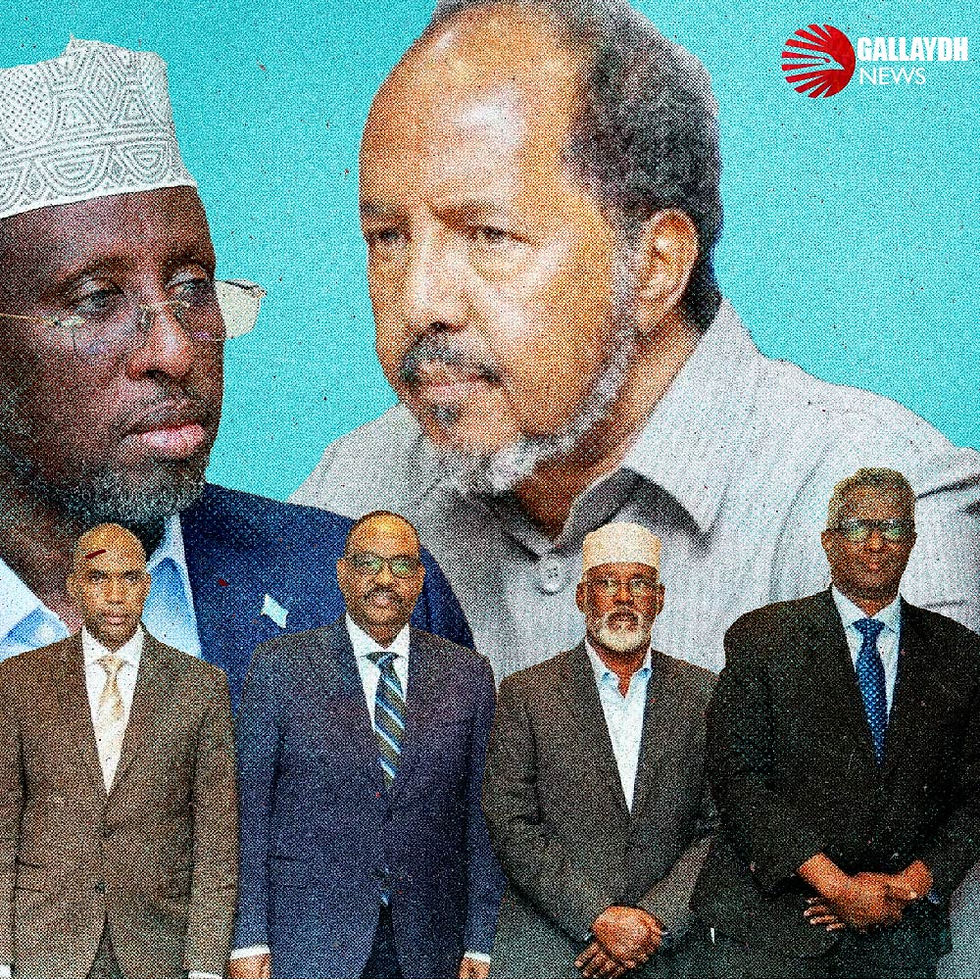
Assessing the Legacy of Hassan Sheikh Mohamud: Governance, Conflict, and a Looming Constitutional Crisis

MOGADISHU (May 15, 2026) May 15, 2026, officially marks the expiration of the constitutionally mandated term of the President of the Federal Republic of Somalia, Hassan Sheikh Mohamud. When he was elected on May 15, 2022, he entered the history books as the first Somali president to be elected to two non-consecutive terms.
His return to power was accompanied by high hopes and great expectations that he would resolve the paralyzing political disputes left behind by his predecessor, Mohamed Abdullahi Farmaajo. He took over the reins of the country during a transitional period defined by deep political confusion and widespread insecurity. However, the past four years have been characterized by limited victories and significant, far-reaching failures that have fundamentally reshaped Somalia's political and security landscape.

As his term ends, how will Hassan Sheikh Mohamud's second administration be remembered? What is the legacy he leaves behind at Villa Somalia as he faces the greatest political pressure of his career?
1. The War Against Al-Shabaab: Early Victories and Painful Retreats
One of the central pillars of Hassan Sheikh's presidential campaign was the eradication of the Al-Shabaab militant group. Upon taking office, he launched a massive military offensive heavily supported by local clan militias known as the Macawiisley. Initially, this operation yielded tangible successes, with the government reclaiming highly strategic areas and major towns.
However, these victories proved unsustainable. The government's military strategy appeared to rely on a "capture and hold" approach without possessing sufficient military capacity or holding forces to secure the liberated territories. This tactical oversight resulted in Al-Shabaab recently recapturing highly strategic areas where much blood had been shed, including Aden Yabal, Masjid Ali Gaduud, Moqokori, and Biyo Caddo, all located within the Hiraan and Middle Shabelle regions. These severe reversals have deeply diminished public confidence in the federal government's ability to fully pacify the country.
2. Clashes with Regional States: Power Grabs and Political Fractures
Like many Somali presidents who arrive at Villa Somalia, Hassan Sheikh aggressively attempted to centralize executive power. This approach directly pitted him against the country's Federal Member States. He engaged in fierce political and armed conflicts with the administrations of Jubaland and South West State.
His attempt to control or unseat Jubaland leader Ahmed Madobe completely failed, starkly highlighting the limits of Villa Somalia's power outside the capital. Conversely, although he placed immense political pressure on South West State, he failed to gain full control, leading to a protracted and bitter dispute with its leader, Abdiaziz Laftagareen, eventually toppling him. This relentless power struggle has severely weakened the vital cooperation between the federal government and regional administrations.
3. Indirect Elections: Partisan Gains and Weak Democratic Institutions
Although he frequently promised on public stages to deliver a one-person, one-vote universal suffrage system, the elections recently held in South West State and the Banadir Region were entirely detached from that democratic ideal. Instead, a highly manipulated, indirect system was implemented to easily secure seats for his ruling UPD party. This reality reaffirmed the traditional norm in Somali politics where the incumbent shapes the electoral process entirely to serve his own interests, thereby shattering the public's hope for genuine democratic representation.
4. The Somaliland Dispute: Diplomatic Threats and Ultimate Failure
One of the defining crises of Hassan Sheikh's tenure was his reactionary response to the January 2024 Memorandum of Understanding signed between the Republic of Somaliland and Ethiopia. The geopolitical move generated massive anger in Mogadishu. In response, Hassan Sheikh launched an aggressive global diplomatic campaign aimed at crippling the agreement, arguing it was a blatant violation of Somalia's sovereignty.
Ultimately, this diplomatic crusade appears to have failed. He was unable to convince the international community to sanction Ethiopia or to sever their geopolitical ties with Somaliland. His broader efforts to obstruct Somaliland's quest for international recognition also proved futile, as Somaliland successfully utilized the momentum to strengthen its strategic relationships with various countries across the globe.
5. Relationship with the Prime Minister: Genuine Loyalty or Engineered Weakness? Throughout Somalia's modern political history, bitter conflicts between the President and the Prime Minister have been a constant feature that has paralyzed consecutive governments. Hassan Sheikh made history as he and his Prime Minister, Hamza Abdi Barre, completed the past four years together without a single reshuffle, an incredibly rare occurrence in the last two decades.
However, political analysts argue that this stability does not stem from genuine political consensus or effective power-sharing. Rather, it is the result of the president deliberately selecting a highly compliant Prime Minister who lacks the political base and independent power to resist presidential directives. This dynamic has effectively concentrated all executive power into the hands of one man, weakening the broader checks and balances of the government apparatus.
6. Plundering Public Land and Displacing Vulnerable Citizens
One of the heaviest moral and legal criticisms leveled against Hassan Sheikh's administration is the rampant mismanagement of public assets. Over the past few years, public lands and government facilities in Mogadishu have been aggressively privatized and sold off. The sale of this land has directly impacted thousands of impoverished families, many of whom were vulnerable returnees from the civil war. These citizens were forcefully evicted from their settlements to make way for wealthy businessmen and individuals with close, lucrative ties to the inner circle of the government.
7. Constitutional Amendments: A Highly Contentious Project
The aggressive push to amend Somalia's Provisional Constitution has become the most controversial and destabilizing issue of his presidency. The political opposition and certain regional states, particularly Puntland, have fiercely opposed this overarching plan, describing it as a blatant attempt by Hassan Sheikh to hijack national power and systematically dismantle the federal system. The process through which the amendments were rammed through the legislature is widely viewed as non-inclusive, lacking the full confidence, transparency, and consensus of the Somali public.
The End of the Term and the Coming Crisis
Today, on May 15, 2026, Hassan Sheikh Mohamud finds himself at a highly dangerous geopolitical crossroads. With his constitutional term officially expired, he faces immense, mounting pressure from the political opposition, regional state leaders, and the international community, all of whom are unequivocally demanding the timely execution of national elections.
Although the President claims that the newly amended constitution legally grants him the authority to remain in office for an additional year to organize these elections, the opposition vehemently rejects this premise. They argue that such an extension is entirely illegal and represents an open violation of the nation's fragile social contract.
Somalia is now standing on the brink of a massive constitutional crisis and potential political chaos. The overarching question remains: Is Hassan Sheikh Mohamud willing to save the country from institutional collapse by agreeing to genuine dialogue and political compromise, or will he drag the troubled nation back into turmoil and civil conflict merely to hold onto the presidency? The coming days will reveal the ultimate fate of this fragile nation.