How Mohamed Kahin Ahmed’s Legacy and Discipline Redefines the 2029 Presidential Race

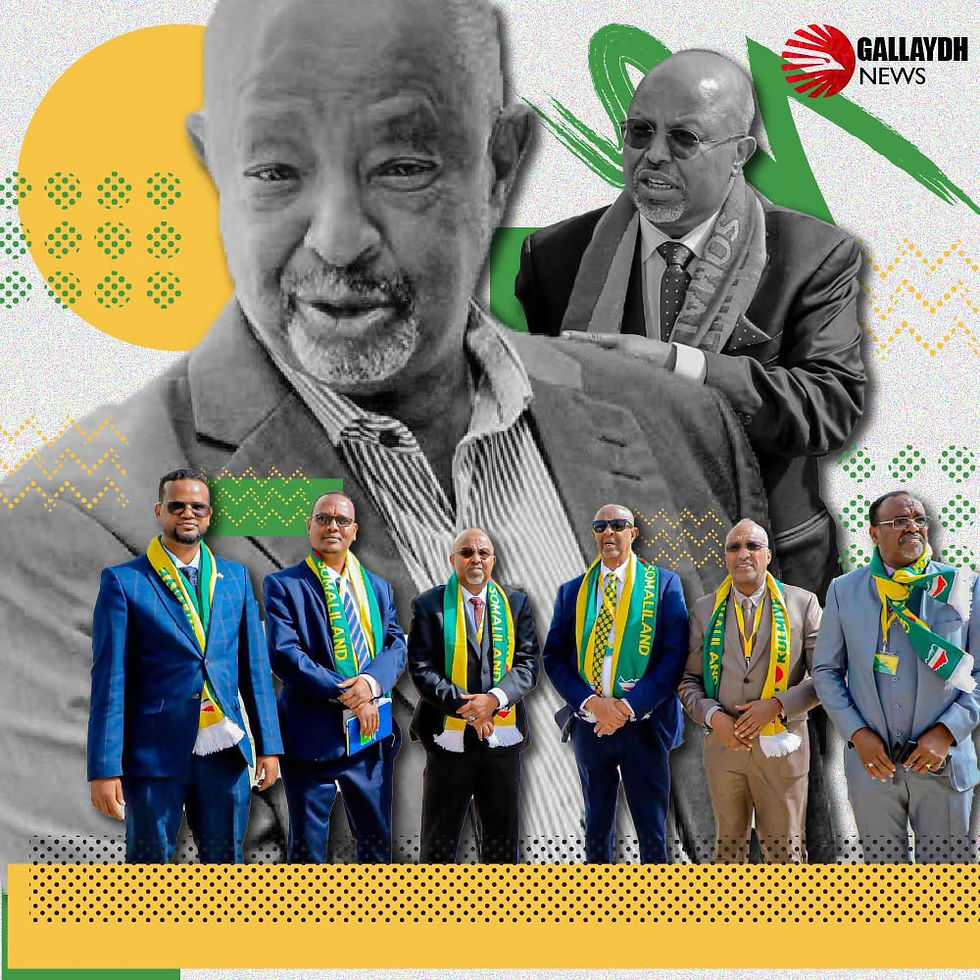
When delegates of the KULMIYE party formally elected Mohamed Kahin Ahmed as their presidential candidate for the 2029 general elections, they elevated only the third standard-bearer in the party's quarter-century history. Following in the footsteps of former Presidents Ahmed Mohamed Mohamoud (Silanyo) and Muse Bihi Abdi, Kahin now shoulders the responsibility of leading Somaliland’s oldest political institution back to executive power.
Yet Kahin is neither a conventional politician nor a newcomer to the corridors of authority. With a career in public life spanning more than four decades, he represents a rare bridge between the foundational military struggle for Somaliland’s survival and the contemporary challenges of state-building. As political parties begin positioning themselves for the 2029 electoral cycle, Kahin brings a distinct set of personal, historical, and ethical differentiators that separate him from the current class of political contenders.

A Four-Decade Institutional Pedigree: From the SNM Vanguard to the Ministry of Interior
In an era where political careers are often built on short-term coalitions and media visibility, Mohamed Kahin Ahmed’s resume is unmatched in historical depth. He is widely recognized as one of the "first four" military officers to cross into opposition territory and lay the structural foundations of the Somali National Movement (SNM) in the early 1980s.
His institutional service tracks the entire evolution of the modern Somaliland republic:
The First Republic Cabinet: Following the declaration of independence in 1991, Kahin served among the foundational cabinet ministers under Somaliland’s first president, Abdirahman Ahmed Ali (Tuur), helping to establish rudimentary civil administration in a post-conflict landscape.
Political Pluralism and Opposition Resilience: He was a primary architect of the ASAD political association during the early transition to multiparty democracy. Later, as an organizer within KULMIYE, he spent eight years as a disciplined opposition strategist, building the grassroots machinery that would eventually sweep the party to power in 2010.
The Longest-Serving Interior Minister: During Muse Bihi Abdi’s administration, Kahin held the portfolio of the Ministry of Interior for seven consecutive years, making him the longest-serving interior minister in Somaliland’s history. In this capacity, he managed national security, internal territorial administration, and complex local peacebuilding dockets during periods of severe geopolitical pressure.
Integrity: A Career Unstained by Fiscal Patronage
Perhaps the most remarkable differentiator in Mohamed Kahin Ahmed’s political profile is his reputation for financial probity. In developing democracies, executive portfolios with vast discretionary budgets often become entanglements for personal enrichment, patronage networks, and illicit capital accumulation. The Ministry of Interior is among the most well-funded and powerful state organs in Somaliland.
Despite overseeing this sensitive portfolio for seven years under his close political ally, former President Muse Bihi Abdi, Kahin’s record remains free of corruption scandals, state-resource embezzlement, or fiscal impropriety.
A Cross-Party Consensus on Uprightness:
In a political culture where allegations of graft are routinely weaponized by partisan opponents, both supporters and fierce opposition figures acknowledge that Kahin has never diverted public funds for personal wealth accumulation. There are no sprawling private real estate developments, commercial monopolies, or hidden corporate holdings attributed to his name.
This clean fiscal ledger equips KULMIYE with a powerful moral narrative for the 2029 campaign. At a time when working-class Somalilanders are increasingly sensitive to administrative bloat and elite wealth disparities, Kahin presents as a public servant who views public office as a duty rather than an avenue for personal enrichment.
Undivided Allegiance and the Absence of Dual Citizenship
A defining feature of contemporary Somaliland politics is the heavy presence of diaspora elites. Many senior political figures, cabinet ministers, and party leaders hold dual citizenship, carrying Western passports from Europe, North America, or the Gulf. While the diaspora has historically contributed immense intellectual and financial capital to Somaliland, dual citizenship often invites public skepticism regarding undivided loyalty and long-term commitment to the homeland.
Mohamed Kahin Ahmed stands as a striking exception to this norm:
Purely Domestic Anchorage: Like his long-time comrade Muse Bihi Abdi, Kahin has lived continuously within Somaliland. He possesses no foreign passport, holds no dual citizenship, and maintains no secondary residency abroad.
The Politics of Presence: In the popular imagination, his singular citizenship reinforces an authentic bond with the ordinary electorate. He is perceived not as a transnational elite who can retreat to a foreign capital in times of crisis, but as a resident statesman whose entire fate is tied to the soil of Somaliland.
Substance Over Media Grandstanding
Contemporary political campaigning is increasingly dominated by social media theatricality, curated press briefings, and performative rhetoric. Kahin’s governance style runs counter to this trend. He is fundamentally a quiet operator who avoids gratuitous media appearances and unnecessary public grandstanding.
Throughout his tenure as Minister of Interior, he rarely held press conferences unless national security imperatives required official communication. This measured, low-profile approach has cultivated an image of a serious, work-oriented administrator who prioritizes institutional execution over public relations playbooks.
The Age Factor and Institutional Resilience
At 73 years old, Mohamed Kahin Ahmed enters the 2029 electoral cycle as a senior statesman. In any democratic system, the age of a prospective head of state invites scrutiny regarding stamina, adaptability, and generational alignment.
However, Kahin has addressed this subject with characteristic military frankness. During a candid 2022 television interview with journalist Hassan Gallaydh on HCTV, he was asked directly whether his age would present an obstacle to a future presidential bid. Kahin dismissed the concern, emphasizing that his physical discipline as a former soldier and his decades of institutional endurance make age an asset of seasoned judgment rather than a liability of energy.
Furthermore, by securing his party’s nomination in mid-2026, Kahin has granted KULMIYE a critical first-mover advantage. While rival political organizations remain bogged down in internal jockeying for their 2029 tickets, KULMIYE has already settled its presidential and vice-presidential lineup, allowing three full years for grassroots organization and policy formulation.
Conclusion
While Mohamed Kahin Ahmed’s individual strengths provide KULMIYE with a formidable candidate, his immediate path to executive victory faces a complex internal challenge.
His election as the presidential standard-bearer occurred during a Central Committee convention that was boycotted by his long-time political ally, former President Muse Bihi Abdi, alongside several influential party figures. This internal estrangement stems from disagreements over the party’s post-2024 restructuring and the timing of the presidential nomination.
For KULMIYE to present a winning front in 2029, Kahin’s most urgent political imperative is not outward campaigning, but internal diplomacy. Muse Bihi Abdi remains the historical elder of the party and commands significant loyalty across key voter constituencies.
How Mohamed Kahin manages this delicate transition will define his leadership. If he can bridge the internal divide and unite KULMIYE’s full political weight behind his ticket, his unmatched historical pedigree, clean fiscal reputation, and disciplined leadership style will make him one of the most formidable contenders for the presidency of Somaliland in 2029.