


The Mirage of Crude: Unmasking the 14-Year Delay of Somaliland's Toosan-1 Oil Well

In August 2012, a wave of unprecedented optimism swept across the Republic of Somaliland. The administration of then-President Ahmed Mohamed Mohamoud (Silanyo) officially announced that London-based Genel Energy would commence oil exploration and extraction operations in the country. The corporate promise was immediate and tangible: the first exploratory oil well would be drilled by 2014 in the resource-rich Saraar and Daadmadheedh regions.
Today, fourteen years later, that grand promise has evaporated into a political illusion. The citizens of Somaliland are still waiting for a drop of oil, while three successive administrations have recycled the exact same narrative, repeatedly assuring the public that extraction is just around the corner.
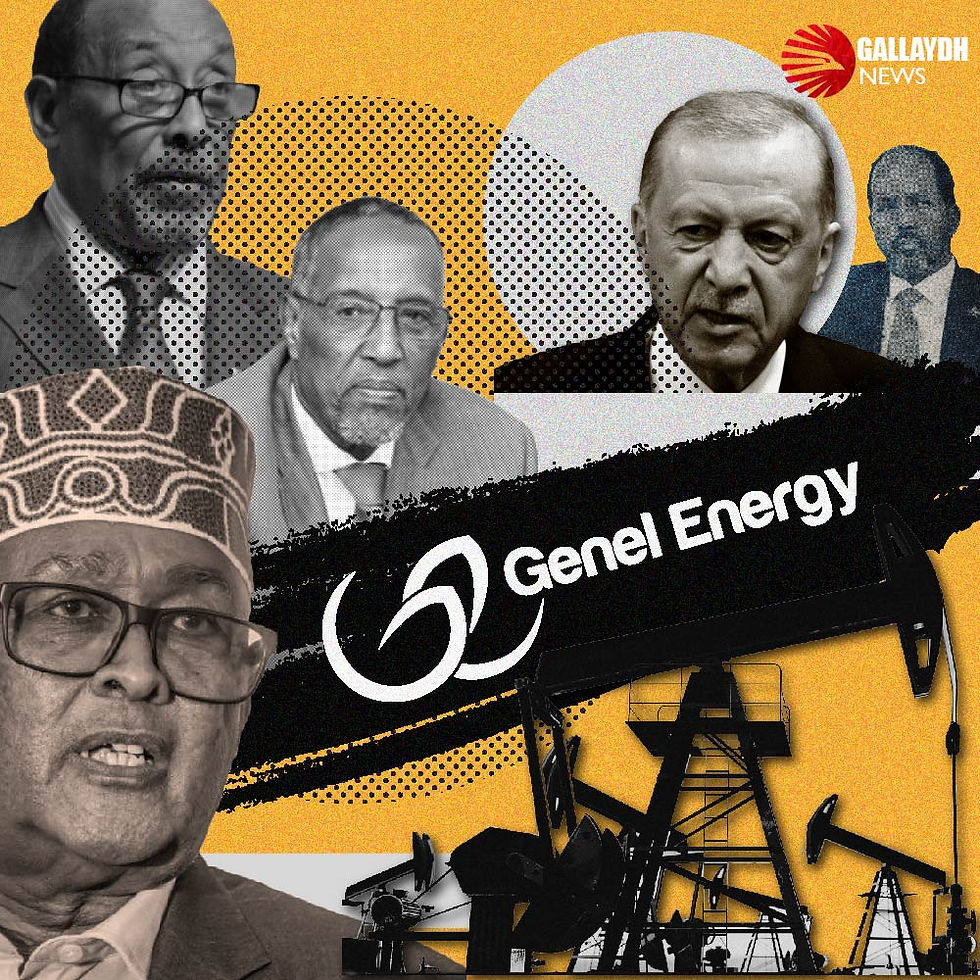
This staggering delay demands rigorous scrutiny. What is the actual reality surrounding Somaliland’s oil reserves? What unseen forces have paralyzed the drilling of the highly anticipated 'Toosan-1' well for over a decade? Most importantly, what is the hidden role of the Turkish government in keeping Somaliland's economic aspirations indefinitely tethered to the ground?
The Turkish Hand Inside Genel Energy
To understand the chronic paralysis of Somaliland’s oil sector, one must first look at the true power dynamics within Genel Energy. While the company maintains its corporate headquarters in London, its ownership structure and executive decision-making apparatus lean heavily toward Ankara.
Official corporate records reveal that three of the five members sitting on the company's Board of Directors are Turkish nationals. Furthermore, the largest declared shareholders are Turkish conglomerates: Bilgin Grup holds 23.75 percent, and Daax Corp FZE holds 17.48 percent. Combined, these two entities control over 41 percent of the company. However, the most alarming detail for economic watchdogs is that 51 percent of the company's shares are held by "Unknown Entities" and are shielded from public disclosure. This lack of transparency fuels widespread suspicion that Turkish financial and political influence within Genel Energy is substantially higher than the declared 41 percent.
Genel Energy’s entry into Somaliland was not the result of an open, competitive international bidding process. Instead, it was the product of aggressive diplomatic maneuvering. Between 2011 and 2015, the Turkish government wielded immense political influence in Hargeisa. As reported by global news outlets in 2012, Turkey actively lobbied on behalf of Genel, leveraging its diplomatic weight to convince the Somaliland government to award the lucrative exploration blocks to the firm.
Comparison of Two Genel Pre-production Blocks: Oman vs. Somaliland
To expose the glaring discrepancies in the company's operational behavior, one only needs to examine Genel Energy’s 2025 Annual Report. The document provides a stark comparison of its "Pre-production assets" across different countries.
Regarding its 'Block 54' project in the Sultanate of Oman, the company outlines a highly detailed, technical, and actionable roadmap. The report notes that the preliminary re-entry and testing of the legacy Batha West-1 well was completed safely ahead of schedule and under budget. It details ongoing analysis of 3D seismic data and explicitly commits to drilling two exploration wells over the next two years, with 2026 dedicated to seismic processing and active drilling preparation.
In sharp contrast, the section dedicated to Somaliland's SL10B13 block is devoid of any technical milestones or financial timelines. The report vaguely states that the company continues to "work towards drilling" the Toosan-1 well. It then awkwardly pivots to highlighting its corporate social responsibility initiatives, noting its close work with local communities on maternal health, education, and environmental projects.
This document reveals a harsh truth. The company has effectively transformed a multi-million-dollar oil exploration project into a localized charity operation. There is no definitive date for when heavy machinery will actually pierce the earth. While financial data from 2025 shows that capital expenditure for pre-production assets nearly doubled to $5.0 million and the company maintained an active ground staff of 23 personnel in Somaliland, this administrative presence has never translated into a single drilled well.
Regional Contrasts and Staggering Delays
The most baffling aspect of this saga is the sheer difference in operational speed when compared to other regional projects. In 2015, Genel Energy initiated drilling operations in the West African nation of Ivory Coast. After testing the site that same year, they confirmed the absence of commercially viable oil and swiftly moved on. Yet, in Somaliland, where the Toosan-1 well in the Qoryaale district was clearly marked in 2012, the company has not dared to drill and verify the reserves for fourteen years.
To fully grasp the magnitude of the time lost, consider what the Republic of Somaliland has accomplished while waiting for Genel Energy. Over the last 14 years, the nation has built the world-class Berbera Port, completed the trans-national Berbera Corridor highway, secured historic diplomatic breakthroughs, transitioned power between three democratically elected presidents, and voted in two separate parliaments. A child born on the day the Genel contract was signed in 2012 is now a 14-year-old teenager.
The contrast becomes even more bitter when looking at neighboring territories. In 2024, the Turkish government signed a hydrocarbon exploration agreement with the Federal Government of Somalia in Mogadishu. Within a matter of months, Turkish offshore exploration vessels were deployed to the Somali coast. This raises an existential question. Why did Turkey mobilize multi-million-dollar drilling ships for Mogadishu in a matter of months, while the Somaliland project remains frozen in a 14-year holding pattern?
Complicity and the Ultimate Question
Regardless of the shifting geopolitical tides, the deterioration of diplomatic relations between Hargeisa and Ankara has done nothing to change the stagnant reality of the oil agreement.
Successive Somaliland administrations bear a heavy burden of complicity. By failing to publicly disclose the true technical or geopolitical hurdles obstructing the project, they have actively participated in misleading the public. President Abdirahman Mohamed Abdullahi (Cirro) recently promised that Somaliland's oil would be extracted by 2027. With that deadline now a mere five months away, there is absolutely no sign of the heavy drilling infrastructure required to make that promise a reality.
The ultimate question facing the Somaliland public and its leadership is simple. Is it logically possible that a corporation largely owned by Turkish billionaires, and deeply intertwined with a Turkish state apparatus that actively opposes Somaliland’s sovereignty, will ever extract oil for Hargeisa? The answer to that question holds the key to understanding why the Toosan-1 well has remained untouched for 14 years.

