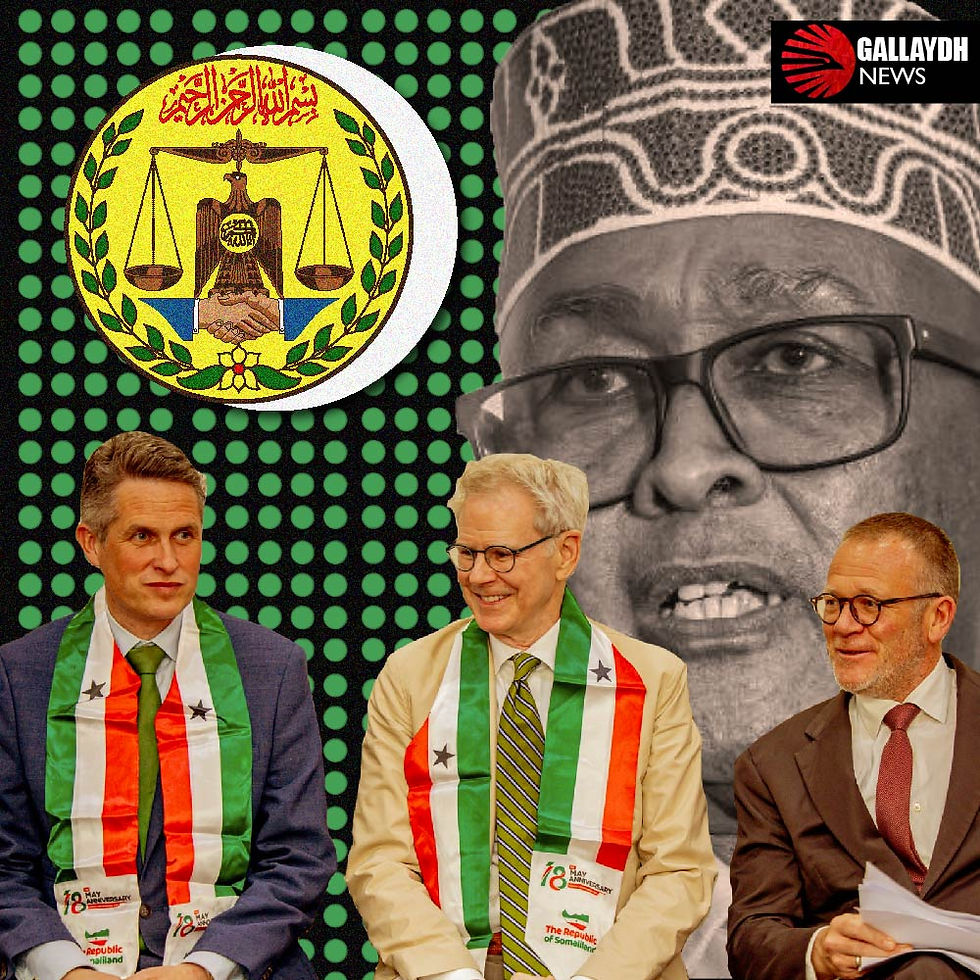
Freedom of Speech Under Attack: Unpacking the Government Crackdown on Lawyer Guuleed Dafac

For more than three decades, Somaliland has proudly positioned itself as a rare beacon of democracy and freedom of expression in the volatile Horn of Africa. Today, however, the nation's political tolerance is facing a severe litmus test. A bitter political and legal standoff has erupted following threatening remarks made by the Minister of Interior, Abdalle Mohamed Arab, who publicly declared that the government would take legal action against a prominent lawyer accused of serving foreign interests and undermining the nation's sovereignty and foreign policy.
Although the Minister deliberately avoided naming the individual during his press conference, the legal fraternity, the press, and the general public immediately understood that the target was Guuleed Ahmed Jama, widely known and respected as Guuleed Dafac. This heavy handed accusation was leveled shortly after Guuleed published a rigorous legal and political analysis on his social media platforms, questioning the government's plan to open Somaliland's new embassy to Israel in the city of Jerusalem.

The Jerusalem Debate and the Question of Recognition
Contrary to the government's harsh framing, Guuleed Dafac's arguments were not an attack on the recent diplomatic pact between Somaliland and Israel. In his videos and writings, he explicitly reiterated his staunch support for the bilateral partnership and Somaliland's broader quest for international recognition. His concerns were rooted entirely in the nuances of international law and diplomatic strategy.
Guuleed correctly pointed out that Jerusalem remains a highly contested territory under international law, at the center of the Israeli and Palestinian conflict. He noted that the vast majority of the international community, including Israel's closest Western allies, maintain their embassies in Tel Aviv to respect international resolutions. He argued that Somaliland, a nation actively seeking the international community to respect its own legal borders and right to self determination, should avoid entangling itself in a complex global territorial dispute. Furthermore, he warned that establishing an embassy in Jerusalem could trigger severe diplomatic backlash from Arab and Islamic nations with which Hargeisa still maintains crucial ties. Therefore, he advised the government to establish the embassy in Tel Aviv to secure the diplomatic victory while avoiding unnecessary geopolitical fallout.
This open discourse is a constitutional right afforded to every citizen wishing to express an opinion on national policy. Yet, the government chose to interpret this pragmatic advice as "foreign collusion" and a rejection of the recognition effort, sparking widespread fears of a new era of intellectual suppression in Hargeisa.
Guuleed Dafac: A Subversive Threat or a Critical Patriot?
The Minister's accusation that Guuleed Dafac is an opponent of Somaliland's recognition fiercely contradicts the lawyer's well documented public record. When the diplomatic memorandum and subsequent recognition from Israel were first announced, Guuleed was among a small handful of intellectuals who fiercely, scientifically, and courageously defended Somaliland's decision on global platforms.
The public record shows that he participated in over twenty international debates, interviews, and published articles across various languages, single handedly dismantling the diplomatic propaganda and attacks emanating from Mogadishu. Many academics and political observers acknowledge that Guuleed's intellectual defense during those critical early days of the recognition announcement was vastly more effective and scholarly than the efforts of the majority of the Cabinet.
Holding a PhD in Law, Guuleed is a homegrown intellectual who transitioned from a university lecturer to one of the nation's most formidable legal minds. He has dedicated his professional life to human rights advocacy, the preservation of the rule of law, and the advancement of Somaliland's state building process. He has never been associated with anti national movements or foreign agendas. This stark reality begs a critical question. Does the government possess actual, tangible evidence of these grave allegations, or is this merely a fabricated political pretext designed to silence a loud and influential critic?
The True Roots of the Conflict
To understand the origins of this clash, one must look beyond the Jerusalem debate and examine the recent history between the lawyer and President Cirro's administration. Guuleed Dafac has never been a passive observer; he is an active, vocal critic of systemic failures. From the very beginning of the new administration, he openly criticized the composition of the Cabinet, questioning the competence and experience of certain appointees.
He has also been at the forefront of campaigns against corruption and inflation. Recently, he publicly condemned the lack of administrative transparency, pointing to allegations that certain government officials had rapidly built luxury two story villas in a suspiciously short period after taking office. Additionally, he led the public outcry against telecommunication companies when they drastically increased internet prices, mobilizing public sentiment and demanding that the government step in to protect struggling consumers.
Analysis: Government Intolerance and the Cost to Freedom
This accumulation of relentless critiques regarding public services, good governance, and now foreign policy appears to have exhausted the government's limited reserves of tolerance. The Minister of Interior's threat carries a chilling message for the public. It suggests that anyone who questions or attempts to correct the strategic decisions of the government will be branded a "foreign agent" and subjected to legal harassment and potential imprisonment.
If the government follows through on its threats and targets Guuleed Dafac simply for exercising his freedom of expression, it will inflict catastrophic damage on Somaliland's democratic reputation on the world stage. At a time when Somaliland is aggressively marketing its case for international recognition, its most potent weapon is its identity as a free, law abiding nation that respects independent thought.
Suppressing constructive criticism is not a display of state power; it is a glaring symptom of administrative fragility and insecurity. The international community, particularly the democratic nations whose support Somaliland desperately seeks, is watching these developments closely. Weaponizing the legal system to silence independent voices is a dangerous path, and President Cirro's administration must carefully reconsider its stance before taking steps that could yield devastating consequences both domestically and internationally.