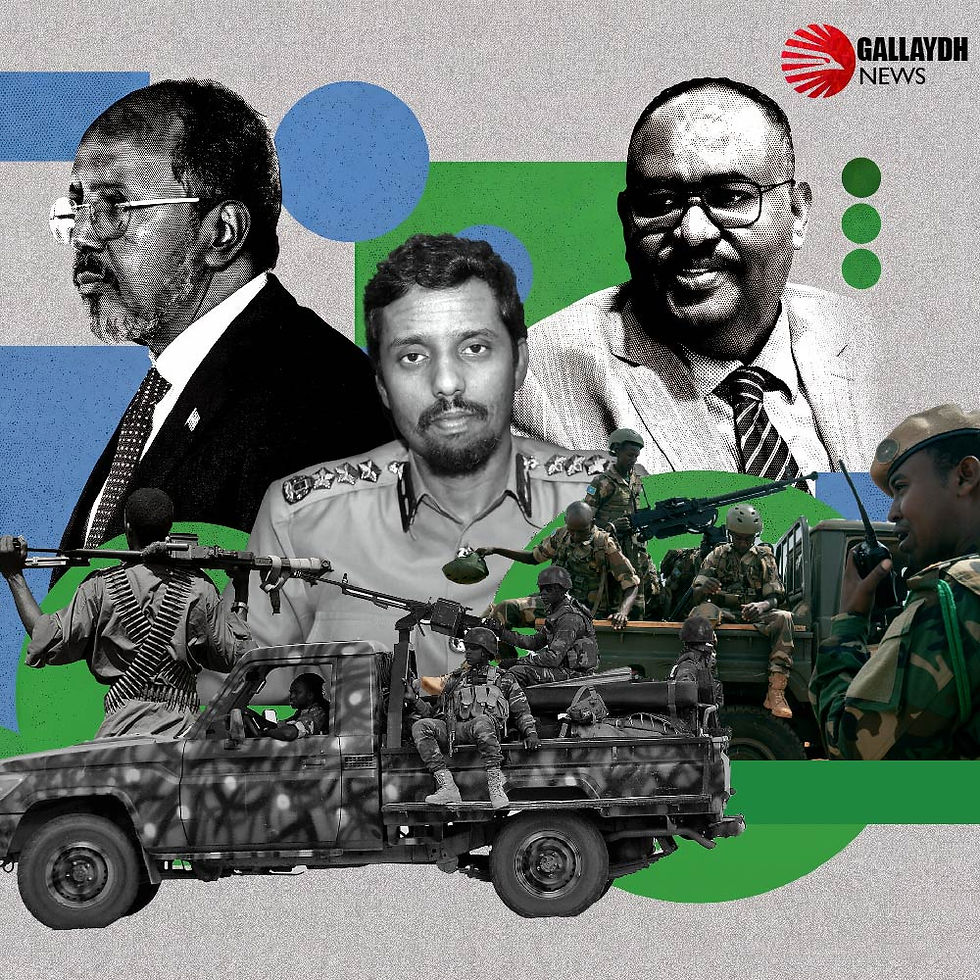
The End of Parallel Armies: How Puntland Outmaneuvered Villa Somalia to Unify Its Security Apparatus

GAROWE (August 14, 2026) In what is being described as one of the most consequential military and political campaigns in its recent history, the semi-autonomous State of Puntland has achieved a sweeping victory under the leadership of President Said Abdullahi Deni. In a matter of weeks, the northeastern state has successfully dismantled and absorbed all parallel security factions and federal-aligned militias operating within its borders. This decisive sweep across the Mudug, Nugaal, Karkaar, and Bari regions has officially purged the state of any armed group not directly accountable to the central command in Garowe.
Fractured Forces: Understanding Puntland's Military Landscape
To grasp the magnitude of Deni's triumph, one must understand the fragmented nature of Puntland's historical security architecture. For years, the state hosted competing centers of military power:
The Puntland Darawiish: The primary, state-sanctioned defense force that takes direct orders from the Puntland Presidency.
The Puntland Security Force (PSF): Originally established as an elite, heavily armed counter-terrorism unit. However, its command structure was historically monopolized by the Diyano family, granting the PSF a dangerous degree of autonomy outside the state's official military hierarchy.
The Danab Brigade (Puntland Contingent): A specialized military wing commanded by General Jimcaale Jama Takar. While operating within Puntland, this unit had recently forged close logistical and financial ties with the Federal Government in Mogadishu.

The Roots of the Crisis: The Deni-Diyano Rivalry
The conflict between President Deni and the PSF is not a recent phenomenon but rather the climax of a protracted power struggle. Deni's initial attempts to bring the PSF under state control sparked bloody urban warfare in the commercial hub of Bosaso. This security crisis rapidly morphed into a political one when Asad Osman Abdullahi (Asad Diyano), a figure with deep roots in the PSF command, ran against Deni for the Puntland presidency and lost.
Following his electoral defeat, the political rivalry was elevated to a national crisis. Somali Federal President Hassan Sheikh Mohamud strategically appointed Asad Diyano as the Chief of the Somali Police Force. This provocative move effectively transformed a localized power struggle into a proxy conflict, with the Federal Government overtly backing Garowe's internal rivals.
The Diplomatic Coup: General Takar's Concession
The most devastating blow to the Federal Government's ambition of cultivating loyalist forces inside Puntland came via a diplomatic breakthrough with General Jimcaale Jama Takar. In a bid to solidify its influence, Mogadishu recently appointed General Takar as the Commander of the 54th Division of the Somali National Army, a division stationed within Puntland.
However, intense backdoor negotiations led by traditional elders and prominent Nugaal politicians, spearheaded by former Puntland President Senator Abdirahman Faroole, yielded a massive concession. General Takar officially rejected his federal appointment from Mogadishu. Instead, he agreed to integrate his Danab forces fully into the Puntland state security apparatus, with Garowe assuming responsibility for their salaries and welfare.
At a highly publicized reception celebrating the agreement, General Takar drew a definitive line in the sand and officially severed ties with Mogadishu.
"I have always been of Puntland, I will remain of Puntland, and I was never absent through its hardships," the General declared.
Base Captures and the Collapse of the Proxy Network
Deni's unification campaign was not limited to the negotiating table. The Puntland forces launched a series of rapid military operations that secured the largest bases previously held by federal loyalists and independent PSF factions.
Security records confirm that in early August 2026, Puntland forces captured a major strategic base in northern Galkayo, followed swiftly by the takeover of the former PSF headquarters in Bosaso. Days later, state security forces assumed control of a military camp in the town of Armo in the Bari region after federal-aligned militias abandoned their posts.
The final nail in the coffin occurred today, as federal-paid troops stationed in the Kur-ilaalo area of the Karkaar region officially surrendered and joined the state administration. These troops previously took orders directly from politicians allied with President Hassan Sheikh. The cumulative effect of these operations signifies the total collapse of Mogadishu's military enterprise within Puntland.
Deni Consolidates Power in Galkayo
To cement these hard-won gains, President Deni convened a high-stakes security briefing last night at the Puntland Presidential Palace in Galkayo, meeting with top military commanders and regional officials from Mudug.
The intensive consultations focused on accelerating the reorganization of forces across the volatile districts of Saaxo, Galkayo, and Galdogob. Deni issued strict directives for the security apparatus to lock down regional borders and prepare for a comprehensive restructuring of the newly integrated forces, ensuring they operate strictly under Garowe's unified chain of command.
Escalation with Mogadishu and Accusations of Treason
Puntland's sweeping victories have triggered shockwaves in Mogadishu, exacerbating an already volatile political and security climate. Recently, Puntland issued a stern warning regarding a scheduled visit by President Hassan Sheikh Mohamud to South Galkayo, a jurisdiction administered by the Galmudug State. Garowe argued that the federal president's tour was a thinly veiled mobilization effort aimed at inciting unrest in a city that is only just recovering from recent armed clashes.
The Federal Government responded with fury. Somali Defense Minister Ahmed Moalim Fiqi outright rejected Puntland's warnings, asserting the President's constitutional right to visit any part of the country, including Galmudug. Fiqi then escalated the rhetoric to unprecedented levels, releasing a statement accusing President Deni of aligning with foreign adversaries, specifically referencing the United Arab Emirates and Ethiopia. Fiqi accused Deni of supporting the dismemberment of Somalia, labeling his actions as high treason.
This accusation highlights a much deeper geopolitical rift. Puntland has maintained independent economic and security ties with Addis Ababa and Abu Dhabi, directly challenging Mogadishu's fierce diplomatic protests over foreign interference and sovereignty disputes in the Horn of Africa.
Conclusion
The eradication of parallel militias and the consolidation of military power under a single, unified command represents a historic triumph for President Said Abdullahi Deni. Despite Villa Somalia's concerted efforts to manipulate Puntland's internal security dynamics using federal funds, local political proxies, and figures like Police Chief Asad Diyano, the resilience of traditional leadership and Garowe's decisive military actions ultimately thwarted the federal blueprint.
However, this regional victory comes at a steep national cost. The political estrangement between Garowe and Villa Somalia has now entered a perilous new phase. With military lines redrawn, state borders heavily guarded, and accusations of treason flying, the prospects for a peaceful reconciliation between Somalia's federal government and its oldest, most powerful member state appear more remote than ever.